25. ドローイングの歴史:線の思考と身体性(第1部:ルネサンス期における「ディゼーニョ」の確立 — レオナルド・ダ・ヴィンチ)
イタリア・ルネサンス期において、ドローイング(素描)の概念は根本的な変容を遂げました。15世紀以前、ドローイングは主に実用的で準備的な職人技——塗りつぶされたり廃棄されたりする一時的な設計図——とみなされていました。しかし、ルネサンスの巨匠たちはドローイングを**「ディゼーニョ(disegno)」**として知られる最高の知的規律へと高めました。単なる技法を遥かに超えて、disegno は知的発明(invenzione)と神聖な構想(デザイン)とを一体化させ、芸術家の内なる精神を物理的に現出させるものでした。ドローイングを通じて、芸術家はもはや単なる職人ではなく、自然界のメカニズムを探求する高潔な思考家とみなされるようになったのです。
この哲学的な転換を**レオナルド・ダ・ヴィンチ(1452–1519)**ほど見事に体現した芸術家はいません。レオナルドにとって、スケッチブックは単なる工房の記録帳ではなく、人間の思考のための動的な実験場でした。赤チョーク(サンギーヌ)、ペンとインク、金属筆(メタルポイント)を使い、レオナルドは何千枚もの独立した用紙を絶え間ない探求で埋め尽くしました。それらは繊細な解剖学の研究や植物構造から、水流の乱気流、記念碑的な絵画のための最初の構図にまで及びました。彼のエネルギーに満ちた探求的な線描(punti di vista)は、絶えず動き続ける生命の有機的な力を捉え、ドローイングを静的な成果物ではなく、進行中の「探求のプロセス」として扱いました。
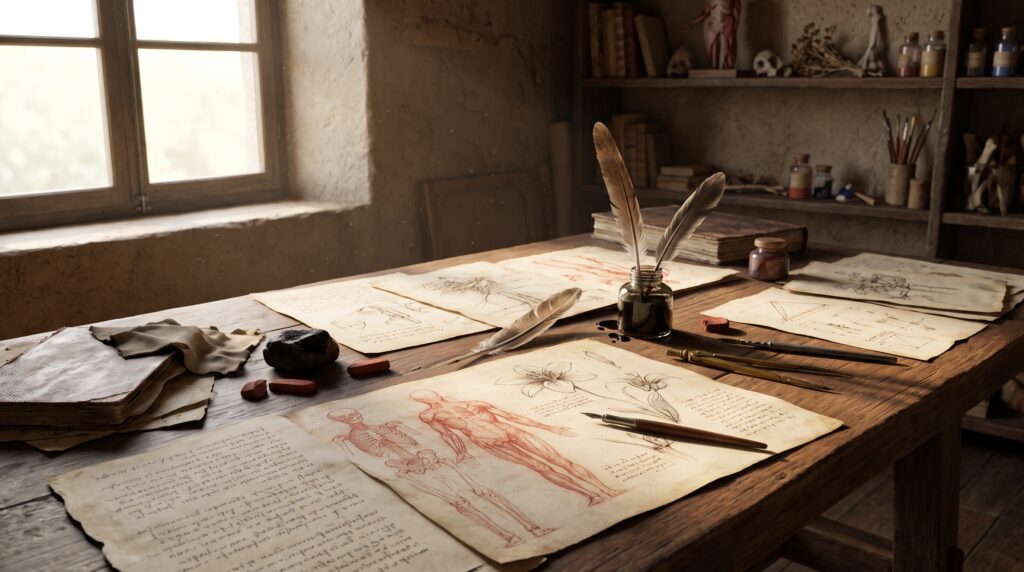
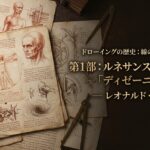
15世紀末フィレンツェのアトリエ。陽光が差し込む大きな木製作業台の上には、レオナルド・ダ・ヴィンチによる赤チョーク(サンギーヌ)やペン・インクの緻密な解剖素描や植物のスケッチ、鏡文字のノートが広げられ、傍らには羽ペンやインク壺、墨が佇む静謐な空間。ここからアートは、人類にとっての知的な遺産として歩み始めた。
決定的なことに、レオナルドのドローイングは科学と芸術の境界線を曖昧にしています。彼の伸びやかなスケッチには密度の高い鏡文字のメモが添えられており、紙の上の1本の線が科学的分析と美学的表現の役割を同時に果たし得ることを示していました。disegno をすべての視覚芸術の根底にある基礎として確立することで、レオナルドとそのルネサンスの同僚たちは、ドローイングを人間意識の究極のメディア——芸術家の魂と目に見える宇宙とを結ぶ、ありのままの直接的な橋渡し——へと変容させたのです。
▼ Read in English (Click to expand)
025. Renaissance Disegno and Leonardo da Vinci (History of Drawing – Part 1)
During the Italian Renaissance, the concept of drawing underwent a fundamental transformation. Before the 15th century, drawing was largely regarded as a practical, preparatory craft—a temporary blueprint to be painted over or discarded. However, Renaissance masters elevated drawing to a supreme intellectual discipline known as disegno. Far more than mere technique, disegno represented the physical manifestation of the artist’s inner mind, unifying intellectual invention (invenzione) with divine design. Through drawing, artists were no longer viewed as simple craftsmen, but as elevated thinkers exploring the mechanics of the natural world.
No artist embodied this philosophical shift more brilliantly than Leonardo da Vinci (1452–1519). For Leonardo, the sketchbook was not just a workshop record, but a dynamic laboratory for human thought. Using red chalk (sanguine), pen and ink, and metalpoint, Leonardo filled thousands of loose sheets with restless explorations—ranging from delicate anatomical studies and botanical structures to turbulence in water and initial compositions for monumental paintings. His energetic, searching lines (punti di vista) captured the organic forces of life in constant motion, treating drawing as an ongoing process of inquiry rather than a static product.
Crucially, Leonardo’s drawings blur the boundary between science and art. His spontaneous sketches were accompanied by dense, mirror-written notes, demonstrating that a single line on paper could simultaneously serve as scientific analysis and aesthetic expression. By establishing disegno as the fundamental foundation of all visual arts, Leonardo and his Renaissance peers transformed drawing into the ultimate medium of human consciousness—a direct, unvarnished bridge between the artist’s soul and the visible universe.
本記事の英語原文(読解クイズ付き)は、note.comの連載『アート系英文読解』で公開しています。アートの知識と一緒に英語力を身につけたい方は、ぜひ[こちら]から挑戦してみてください!
【筆者プロフィール&作品】
このコラムは、現代アーティスト・川田祐子が執筆しています。 実際の銅版画作品は、こちらのギャラリーサイトからご覧いただけます。 👉 https://kawadayuko.jp/printmaking/
